


- 1 NBA : why has France become the league’s second-biggest source of talent? The story behind the rise
- 2 1. Before Tony Parker, the pioneers pried open a narrow door
- 3 2. Tony Parker turned the French exception into a real blueprint
- 4 3. From Noah to Gobert, France proved it could produce every kind of player
- 5 5. Paris and Victor Wembanyama have turned France into a strategic market
- 6 Victor Wembanyama has pushed French players into a new class
- 7 France, the NBA’s second nation ?
NBA : why has France become the league’s second-biggest source of talent? The story behind the rise 
There was a time when seeing a Frenchman on an NBA court felt like a proper event. Every appearance was tracked, every contract looked like a door finally cracking open. Now the balance has shifted. American teams no longer ask whether a young French player is good enough to make the leap. They want to know which one is next.
Victor Wembanyama went No. 1 in the 2023 Draft. A year later, Zaccharie Risacher followed him at the same spot, with Alexandre Sarr right behind. Bilal Coulibaly, Tidjane Salaun, Pacome Dadiet and several others have also made the jump, proving this is no longer about one standout star. France has become a priority scouting ground, watched all year round by NBA executives and talent spotters.
But this surge was not built in a few seasons. It came from pioneers who kicked the door open, from Tony Parker widening it, and from several generations proving French players could stick at the top level. It also rests on a respected development system, high-profile youth tournaments and a growing link between the NBA and the French market.
How did a country where pro basketball players spent years in the shadows of footballers become one of the biggest talent pools for the world’s top league? The answer starts long before Wembanyama, back when going to the NBA still felt like a gamble with no guaranteed return.
[youtube v=”quejVNwzYLI” maxwidth=”560px”]
1. Before Tony Parker, the pioneers pried open a narrow door
11 November 1997 holds a special place in French basketball history. That night, Tariq Abdul-Wahad stepped on court for the Sacramento Kings against the Miami Heat. He became the first French player to appear in an official NBA game. The symbolism was huge, even if his own US career never quite matched the trail he blazed.
Before him, others had already come close to a league that seemed almost out of reach. French players had been watched or had tried their luck, without ever quite sticking. Back then, there was no clear route from a French academy to an NBA rotation. Crossing the Atlantic meant winning over bosses still wary of European prospects and adapting to a game with very different rules and demands.
🇫🇷 [TOP 10] Les meilleurs Français en NBA@vince_jay rend ici hommage au pionnier Tariq Abdul-Wahad… mais quelle place a-t-il dans ce top ? Découvrez nos classements, nos débats, et donnez-nous votre Top 10 à vous.
La vidéo➡️https://t.co/6C3eTrIkdZ pic.twitter.com/YRCdesnwH2
— BeBasket (@Be_BasketFr) July 15, 2020
Abdul-Wahad did more than just play. He made the idea real. A French player could be drafted, make a roster and go up against the best in the world. In his wake, Jerome Moiso and other French prospects drew the attention of NBA teams, each with a very different path.
That early period was still full of doubt rather than clear wins. French players were seen as bets. Some had the physical tools or skill to turn heads, but few arrived with the preparation, support network and knowledge of the system that modern prospects now take for granted.
The crack in the door was there. What was missing was a player who could push through it, stay there and change how the whole country was viewed.
2. Tony Parker turned the French exception into a real blueprint
A year before his Draft, Tony Parker had already made his statement. In July 2000, at Zadar, France’s junior team won the European title. The Paris Basket Racing point guard led a group that also included Boris Diaw, Ronny Turiaf, Mickael Pietrus and Yakhouba Diawara. All of them would later try their luck in the NBA.
That team was one of the first big signs that the landscape was changing. France was no longer just producing one player who might catch American eyes. It was producing an entire group capable of competing with Europe’s best before aiming even higher.
In 2001, San Antonio took Parker with the 28th pick. Nothing about it was obvious. Gregg Popovich was demanding, the Spurs already had huge ambitions and the young guard had to learn quickly how to run a team built around Tim Duncan. It took him only a few months to settle in.
Boris Diaw et Tony Parker trouvent les chemins des filets 🇫🇷
En live sur YouTube et Twitch pour un ÉNORME match, Spurs – Cavaliers en 2015 🔴 pic.twitter.com/olsspfzDfO
— First Team (@FirstTeam101) March 17, 2025
What followed changed the way French players were seen for good. Parker won four NBA titles, made six All-Star Games and, in 2007, became the first European to be named Finals MVP. That award went far beyond his own career. It proved a French-developed point guard could be the best player in a series at the very top of the game.
San Antonio soon became a key part of the story. The Spurs signed Boris Diaw, Nando De Colo, Ian Mahinmi and Livio Jean-Charles, before later landing the top pick that let them take Victor Wembanyama. The bond between the Texas franchise and France was never part of some grand masterplan, but it has now stretched across generations.
Parker also gave younger French players something to believe in. Before him, the NBA could feel remote. After his early titles, it became a real target. His career showed you did not need to come out of an American college or arrive as a top pick to make it. You needed the right organisation, the willingness to grind and the nerve to take your chance.
Tony Parker prend sa retraite
À travers ses 18 saisons c’est :
– Une légende de l’équipe de France
– Un pionnier de la France en NBA
– Un palmarès exceptionnel (4xNBA Champ ;1xMVP des finales ;6xAll-Star…)
Il à créé une ouverture et une place à la France en NBA
MERCI TONY 🙏 pic.twitter.com/2dxN1cWJnm— KC Miura EN VCT (@KBBGMOB) June 10, 2019
The Zadar generation cashed in on that opening. Diaw became one of the smartest, most versatile players of his era, then reunited with Parker in San Antonio and won the title in 2014. Turiaf won a ring with Miami in 2012. Pietrus carved out years in the league with his defence and athleticism. France was no longer represented by one outlier. It was starting to put multiple players on the map at once.
Try it for $0.99.

3. From Noah to Gobert, France proved it could produce every kind of player
Tony Parker’s success could have been filed away as the story of a freak talent landing in the perfect setup. The next decade showed that wasn’t the case. More French players broke through, each with different skills, roles and journeys.
Joakim Noah marked a fresh shift. Partly developed in the United States and a two-time college champion with Florida, the Chicago Bulls big man became one of the NBA’s best defenders. Named Defensive Player of the Year in 2014, a member of the All-NBA team and a two-time All-Star, he showed a French player could matter at the very top through energy, reading of the game and sheer intensity.
La France, c’est la défense 🇫🇷
Joakim Noah.
Rudy Gobert.
Victor Wembanyama.Trois tricolores nommés défenseurs de l’année dans l’histoire de la NBA.
Et Victor va poser un verrou dessus. pic.twitter.com/sl9Uz6igDB
— TrashTalk (@TrashTalk_fr) April 20, 2026
Nicolas Batum found his lane through versatility. He could guard multiple positions, run an offence or knock down shots from deep, and he rolled with the times without needing one fixed role. Portland, Charlotte, the Clippers and others all found a player who could fit what a contending team needed.
Evan Fournier took a different path. A scorer, creator and big-moment player, he became one of French basketball’s main offensive faces. His career confirmed that guards developed in France could also find a place in a league that demands shooting, pace and quick decisions.
Rudy Gobert took that recognition even further. Long written off for being too slight at the time of his Draft, he rebuilt his body and his game until he became a defensive benchmark. His multiple Defensive Player of the Year awards have firmly placed a Frenchman among the league’s most influential players.
Around them, Boris Diaw, Ian Mahinmi, Kevin Seraphin, Rodrigue Beaubois, Frank Ntilikina, Killian Hayes and Guerschon Yabusele have all represented other routes in. Not all of them found the same success, but their steady presence helped make normal what had once seemed exceptional.
That may be the biggest change of all. France does not produce just one type of player. It has sent point guards, scorers, versatile wings, elite defenders and big men who can adapt as the game keeps changing. For NBA teams, signing a French player is no longer tied to one exact profile. It’s now a standard option for almost any need.
This constant presence cannot be understood without looking back at France’s development system. The elite youth hubs, pro academies, the national training centre and INSEP all help spot the best prospects early. Young players are guided on the sporting, physical and academic sides, then gradually pushed up to a higher level.
What makes France different is the closeness to the pro game. Plenty of prospects are facing grown men at a very young age, sometimes before they are even adults. They learn about heavy contact, tactical demands and the pressure of results long before they reach the NBA. Where some American recruits mainly go through college basketball, France’s best can already be logging minutes in a pro league.
Youth international competitions then act as the first real spotlight. EuroBasket U16, U18 and U20, the U19 World Cup, warm-up tournaments and European club competitions are all watched closely by scouts. NBA teams are no longer discovering French players a few weeks before the Draft. They are tracking them for years.
🇫🇷 The Timeo Pons show yesterday against Germany at Euro U20…👀☔
23 points, 10 rebounds, 3 steals, 6/9 from deep… The man was cooking. pic.twitter.com/ElwDdPqBba
— 50 Nuances 🇺🇸🏀 (@50NuancesDeNBA) July 14, 2026
The 2021 U19 World Cup final is one of the clearest examples. Against the United States and Chet Holmgren, France came painfully close to the title. Victor Wembanyama, still only 17, was already turning heads with his size, mobility and ability to take over defensively. That day did not make him an NBA prospect overnight. Scouts already knew him. But his performance showed the whole world that a truly unusual talent was emerging in France.
Others have followed the same path. Bilal Coulibaly grew alongside Wembanyama with the Metropolitans 92. Zaccharie Risacher developed between ASVEL and Bourg-en-Bresse. Alexandre Sarr took an international route after his early years in France. Tidjane Salaun caught the eye at Cholet. They were all viewed in different settings, but they shared the same base.
The success of the youth teams only strengthens that reputation. A medal or a big run does not guarantee an NBA career, but it does show the depth of a generation. For an American scout, going to see one French prospect often means discovering three or four more.
That shift matters. NBA scouts do not come to France anymore just to see the next big thing everyone is talking about. They come because they know the next interesting player might be at Nanterre, Cholet, Bourg-en-Bresse, Le Mans, ASVEL, Paris or the national training centre. The whole country has become a hunting ground.
5. Paris and Victor Wembanyama have turned France into a strategic market
The link between France and the NBA is no longer just about exporting players. The North American league has steadily planted itself in Paris, staging regular-season games, commercial activations and plenty of events aimed at both fans and young players.
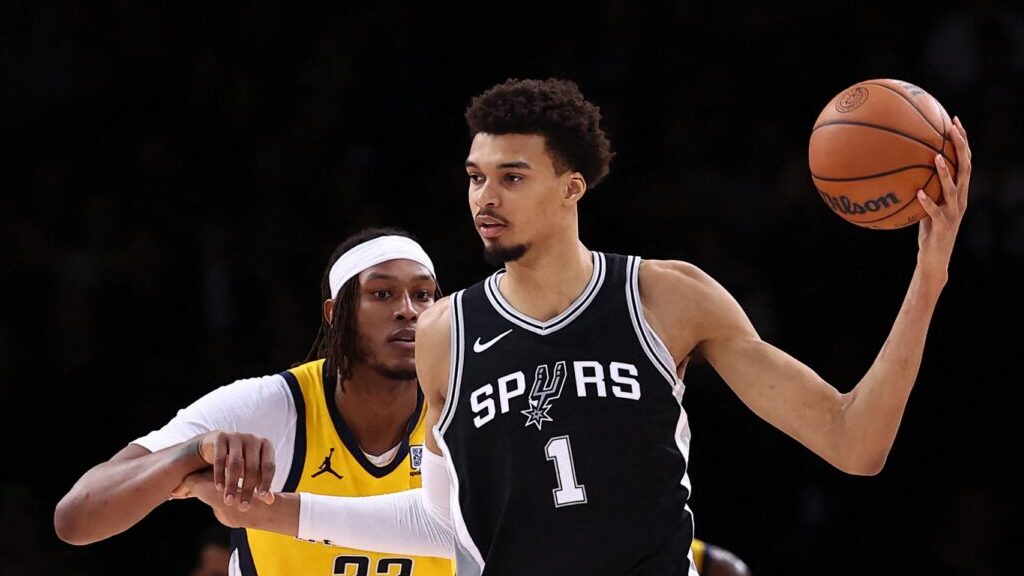
Since 2020, the NBA Paris Games have made January a fixed date in the diary. The arrival of the Spurs and the Pacers in 2025 took it up another level. For the first time, two regular-season games were held in Paris in the same edition. Officially, Indiana was the home team in the first one. In the stands, though, nobody was really fooled: San Antonio was basically at home.
Wembanyama jerseys were everywhere. Spurs ones, of course, but also France, Nanterre and the Metropolitans 92. Every time the Frenchman did anything, the reaction went way beyond the rest of the game. For a few days, the NBA had not simply moved two games to Paris. It had brought one of its new faces back to his own country.
That meeting of worlds had started a few months earlier at the 2024 Olympics. France’s men reached the final against the United States, powered by a crowd fully on their side. Wembanyama confirmed his status, but he was not the only one whose profile went up.
Guerschon Yabusele made a huge impression with his energy and his thunderous dunk on LeBron James. His Olympic run helped him get back into the NBA, several years after a rough first stint. His story sums up what Paris 2024 gave French basketball: a global stage where players based in Europe could remind NBA franchises exactly what they were worth.
Bruh they showed that dunk like 4 times in different angles 😂😂😂😂😂
No klutch foot print on this doc hahahahag pic.twitter.com/77bjjB09ub
— 𝐋• (@clarkkent415) February 19, 2025
The Games also gave major exposure to Mathias Lessort, Isaia Cordinier, Matthew Strazel and the rest of the group. France was no longer represented only by its NBA players. It had a team good enough to push Team USA deep into the final minutes of an Olympic final.
The NBA has understood the value of that. It has stepped up its work with French basketball, especially around development and the broadcast of LNB games. Paris has become a key part of its European strategy, helped by a big fan base, commercial partners and a generation of players the public can actually recognise.
So France produces talent for the NBA, but it gives the league something else too: a market, a growing basketball culture and a prime gateway into Europe. That two-way relationship explains why the connection now goes far beyond the Draft.
Victor Wembanyama has pushed French players into a new class
Tony Parker proved a French player could win titles, become an All-Star and take home Finals MVP. Rudy Gobert and Joakim Noah showed that a Frenchman could establish himself among the league’s best defenders. Victor Wembanyama has moved the bar again.
In 2023, San Antonio took him first overall in the Draft. No French player had ever been selected that high. He arrived with expectations rarely seen for an international player, having been billed for years as someone who could change a franchise’s future.
His first season quickly showed this was not just a marketing exercise. Wembanyama won Rookie of the Year, piled up unprecedented statistical lines and established himself as one of the most watched players in the league. In 2026, he hit another milestone by becoming the first French player voted in as a starter for the All-Star Game.
His impact goes beyond his own numbers. Young French players are no longer viewed only as polished role players or long-term projects. Some are now being assessed as possible franchise faces.
The 2024 Draft proved it in dramatic fashion. Zaccharie Risacher went first overall, ahead of Alexandre Sarr. Two French players took the top two picks, just one year after Wembanyama went No. 1. Tidjane Salaun also went in the first round, along with Pacome Dadiet.
That run changes how the NBA sees France. One strong class can still happen by chance. But several straight years of players going high point to a system that keeps producing.
Behind them, other names keep the pipeline moving. Noa Essengue, Nolan Traore, Maxime Raynaud, Noah Penda and several other youth team prospects show this is nowhere near over. Not all of them will become stars, and some may never stick in the NBA. But French names are now a near-constant in Draft talk.
Wembanyama is the latest peak of a story that started with the pioneers. He is also the starting point for a new era. An era in which a French player can be seen not just as someone who can make it in the NBA, but as one of the talents the league can build its future around.
The 2026 MVP will be announced tonight by @NBAonPrime from 1.30am…
The question is simple…
▪️Shai Gilgeous-Alexander, @okcthunder ?
▪️Nikola Jokic, @nuggets ?
▪️ Victor Wembanyama, @Spurs ?— NBA France (@NBAFRANCE) May 17, 2026
France, the NBA’s second nation ? 
Calling France the NBAs second nation is not an official ranking. Canada, Australia, Serbia, Germany and others have their own star names and a strong history with the league. But no European country currently seems to have stacked up as many advantages over time: a clear development system, steady results at youth level, several generations already established in the NBA, back-to-back No. 1 draft picks and a global force like Victor Wembanyama.
So Frances rise is not built on one special player alone. Tariq Abdul-Wahad cracked the door open. Tony Parker showed a French player could win and dominate at the very top. Diaw, Noah, Batum, Gobert and Fournier proved the talent pool ran deep. Development structures and international competition made that pipeline visible. The Olympics and the NBA Paris Games have finally brought the league and the French public closer together for good.
That is the accumulation behind the question at the start of this piece. France has become a real NBA power because it no longer depends on one generation, one club or one pathway. It now has the full chain, from spotting teenagers to producing players with All-Star potential.
The momentum may even be speeding up. Scouts arrive earlier, young French players understand American expectations better, and teams have more reference points to judge their progress. A player developed in France no longer reaches the NBA without a trail behind him. He arrives after Parker, Diaw, Batum, Gobert, Fournier, Wembanyama and plenty more.
For years, France dreamed of producing one player good enough to make it in the NBA. Now it is NBA front offices that are shaping their schedules to watch the best French youngsters. That flip says almost everything about how far the country has come.
Discover the rest of the NBA news on our mathodds website and app !
in your pocket.
Real-time notifications & alerts


Photo credit : FRANCK FIFE / AFP

Leave a Reply