


- 1 NBA : the “superteams” that never won it all
- 2 The 1998-1999 Rockets, one last shot for three legends
- 3 The 2003-2004 Lakers, four Hall of Famers stopped by Detroit
- 4 The 2012-2013 Lakers, a magazine cover turned nightmare
- 5 The 2018-2019 Celtics, too much talent for one locker room
- 6 The Clippers of Kawhi Leonard and Paul George, the window that kept getting pushed back
- 7 The Nets of Durant, Harden and Irving, inches from a title
- 8 The Suns of Durant, Booker and Beal, three scorers with no balance
- 9 The 76ers and the Process, a “superteam” that changes face every season
- 10 Why do so many “superteams” fail in the NBA?
- 11 Names on paper are not enough to build a champion
NBA : the “superteams” that never won it all 
In the popular imagination, it can seem as simple as stacking a few superstars and taking a shortcut to the NBA title. A front office lands a former MVP, pairs him with another All-Star next to the franchise player, fills out the roster with a few veterans chasing a ring and waits for June. On paper, it looks close to foolproof. On the floor, it usually falls apart.
NBA history is packed with teams built to win right away that never got the job done. Some were undone by injuries. Others never found the right balance between their stars. A few just ran into an opponent who was better prepared. Sometimes all it takes is one missed shot, one knee giving way or one foot landing a couple of inches over the line to turn a historic plan into a massive regret.
Before we get into those failures, though, it is worth agreeing on what a “superteam” actually is. There is no official definition, and the term has split basketball fans for years. For some, any team with multiple All-Stars or future Hall of Famers qualifies. Under that broad view, the Bill Russell Celtics, the Magic Johnson Lakers, Michael Jordan’s Bulls, Tim Duncan’s Spurs or Kevin Durant’s Thunder could all enter the conversation.
That reading, though, ignores how those teams were put together. Kevin Durant, Russell Westbrook, James Harden and Serge Ibaka were all drafted and developed by Oklahoma City. Stephen Curry, Klay Thompson and Draymond Green also grew together at Golden State. Those groups became loaded with talent through the Draft, internal development and years inside the same organization. They were not assembled in a matter of months with the goal of collecting established stars.
That second definition is the one we are using here. A “superteam” is a roster deliberately built through major signings or trades, with several proven stars and one immediate goal: win the championship. That distinction separates homegrown dynasties from projects designed to storm the league. Some of those plans worked, as they did in Boston in 2008 or in Miami after the arrivals of LeBron James and Chris Bosh. For others, the talent pile-up only led to one long run of frustration.
The 1998-1999 Rockets, one last shot for three legends 
By the late 1990s, Houston was trying to extend the window created by its 1994 and 1995 titles. Hakeem Olajuwon and Charles Barkley were still there when the Rockets brought in Scottie Pippen, freshly freed from the Chicago Bulls dynasty. On paper, it did not get much better: a two-time NBA champion at centre, a former MVP and Michael Jordan’s long-time lieutenant.
The reunion immediately had people dreaming. Olajuwon, Barkley and Pippen all brought serious playoff mileage and a truckload of individual honours. Houston was not building for later. It wanted to squeeze one more run out of its aging core and get back to the Finals.
The issue was timing. All three men were past their peak, and the shortened 1998-1999 season, cut down by the lockout, gave them little time to learn how to play together. The Rockets finished respectably, but the group never gave off the sense of total control people expected.
The Lakers knocked them out in the first round. Pippen left Houston after one season, with disagreements over Barkley and the way the team was run hanging over the whole thing. The “superteam” barely existed beyond the hype. That alone summed up one of the model’s biggest flaws: putting legends together does not bring back their best years.
The 2003-2004 Lakers, four Hall of Famers stopped by Detroit 
A few years later, the Lakers pushed the idea much further. Los Angeles already had the league’s most dominant duo in Shaquille O’Neal and Kobe Bryant. The pair had won three straight titles from 2000 to 2002 before losing their crown to the Spurs. To chase the trophy again, the franchise added two future Hall of Famers in Karl Malone and Gary Payton.
Malone was coming off 18 seasons with the Utah Jazz and remained one of the greatest scorers in history. Payton had long been viewed as the most complete point guard of his generation. Both agreed to take less money and accept smaller roles in the hope of landing the one prize missing from their resumes.
Alongside them, the Lakers still had Derek Fisher, Rick Fox, Horace Grant and Phil Jackson on the bench. The roster looked built to handle anything. It had size, creation, defence, experience and two men who could take over a game on their own.
It never really went to plan. Malone missed a big chunk of the season with a knee injury. The tension between Bryant and O’Neal became harder to ignore. Payton struggled to fit into the triangle offence, which cut down his influence with the ball.
Even so, Los Angeles reached the NBA Finals. Against the Detroit Pistons, the Lakers were heavy favourites. They had the names, the experience and the supposed edge in individual talent. Detroit answered with suffocating team defence, better ball movement and a chemistry the Lakers never came close to matching.
The Pistons won the series in five games. Malone retired, Payton was traded, Phil Jackson left and Shaquille O’Neal headed to Miami. In a matter of weeks, the team built to add another banner to the Crypto.com Arena instead brought the end of an era.
Try it for $0.99.

The 2012-2013 Lakers, a magazine cover turned nightmare
In the summer of 2012, Los Angeles tried again. After back-to-back exits before the Western Conference finals, the Lakers landed Steve Nash and Dwight Howard. Nash had won two MVP awards a few years earlier. Howard was still the most dominant centre in the league and had spent years in Orlando as the franchise’s entire reason for being.
Nash and Howard joined Kobe Bryant, Pau Gasol and Metta World Peace. The starting five became one of the defining images of the offseason almost instantly. Some were already picturing another Lakers-Heat showdown for NBA control.
None of it worked.
Nash picked up an injury early in the season and never really found his rhythm. Howard was returning from back surgery and lacked his usual mobility. Gasol’s role kept shifting, and he never seemed fully clear on where he fit. Mike Brown was fired after just five games, then Mike D’Antoni was handed an offence that did not quite suit the roster.
Bryant kept the Lakers afloat through sheer force of will. At 34, he logged huge minutes and piled up scoring nights just to drag the team into the playoffs. In the end, his body broke down. On April 12, 2013, he tore his Achilles against Golden State.
Without their leader, the Lakers were swept by San Antonio in the first round. Howard left for Houston a few months later. Nash played only a handful of games after that before calling it quits. The team that was meant to keep Los Angeles on top became the perfect example of a “superteam” built on big names, but not nearly enough thought about age, health or fit.
The 2018-2019 Celtics, too much talent for one locker room 
Boston is a slightly different case. The Celtics did not just pile up stars from outside. Jayson Tatum, Jaylen Brown, Marcus Smart and Terry Rozier were all drafted by the franchise. But when Kyrie Irving and Gordon Hayward joined a group already boosted by Al Horford, the roster quickly started to look like a “superteam”.
The first season could have signed off on the plan. Even with Hayward suffering a horrific injury in the opener and Irving missing the playoffs, the young Celtics pushed Cleveland to a decisive Game 7 in the Conference finals. The logic seemed obvious: once Boston got its two stars back, it had to be even stronger.
That is not how it played out. Tatum, Brown and Rozier developed so quickly that the pecking order shifted. The young players wanted to keep the responsibilities they had earned during the 2018 run. Irving wanted the team back in his hands. Hayward was trying to get back to his level after almost a full year lost. Brad Stevens had to spread minutes and shots around a group of players who could have been major options anywhere else.
Boston won 49 games, a respectable total but nowhere near the hype. After handling Indiana in the first round, the Celtics took Game 1 against Milwaukee before falling apart. The Bucks won the next four and knocked out a team that had all but lost its collective identity.
Irving left for Brooklyn that summer. Horford went to Philadelphia. Rozier signed in Charlotte. Boston ultimately handed the keys to Tatum and Brown, two homegrown stars. The 2019 failure was a reminder that a roster can have too many answers. When everyone thinks they should be more than a supporting act, depth stops being a strength and turns into a hierarchy problem.
The Clippers of Kawhi Leonard and Paul George, the window that kept getting pushed back 
The summer of 2019 completely remade the Los Angeles Clippers. A few weeks after delivering the first title in Toronto’s history, Kawhi Leonard headed back to California. His signing came with a condition: the franchise had to find him another superstar. The Clippers then sent a mountain of Draft picks and Shai Gilgeous-Alexander to Oklahoma City to land Paul George.
The message was clear. Los Angeles did not want to live in the Lakers’ shadow anymore. The franchise had just put together two of the league’s best two-way wings, both capable of shutting down rival stars and taking over on offense. Around them sat Lou Williams, Montrezl Harrell, Patrick Beverley, Marcus Morris, Ivica Zubac and a batch of useful role players.
The 2019-20 season was meant to be the one. Leonard had just come off a historic run with the Raptors. George had finished third in MVP voting in 2019. The Clippers were deep, experienced and built for the postseason.
Inside the Orlando bubble, though, they never found their rhythm. Absences, late arrivals and locker-room issues kept dragging the group off course. Against Denver in the Conference semi-finals, Los Angeles went up 3-1 and even built several leads that should have closed out the series. The Nuggets kept coming back. In Game 7, Leonard and George simply did not show up when it mattered most.
Doc Rivers was replaced by Tyronn Lue and the roster evolved. Nicolas Batum and Reggie Jackson became important pieces, while the Clippers moved toward a more flexible offense. In 2021, they finally reached the first Conference finals in franchise history. Leonard was no longer around, though. Hurt in the knee against Utah, he missed the rest of the playoffs. Without him, Los Angeles lost to Phoenix.
The seasons after that kept telling the same story. When Leonard and George were available, the Clippers looked good enough to beat anybody. But injuries stopped the project from ever getting a true full run. The 2020 season remains the biggest regret: the roster was intact, the path was there, and the team let a series slip that it had under control.
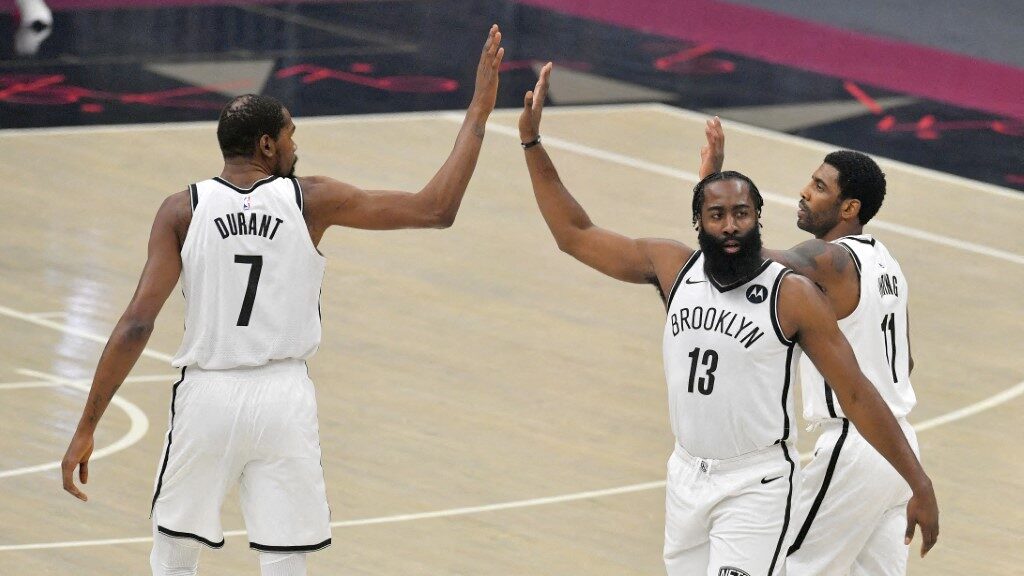
The Nets of Durant, Harden and Irving, inches from a title 
Brooklyn is probably the purest modern version of the “superteam”. In 2019, Kevin Durant and Kyrie Irving chose the Nets in free agency. Durant arrived injured and had to miss a full season, but the franchise was willing to wait. His return was supposed to make Brooklyn an instant title contender.
In January 2021, the Nets went even harder. James Harden wanted out of Houston, and Brooklyn gave up a huge chunk of its depth, plus plenty of Draft picks, to create an offensive trio with almost no equal. Durant, Harden and Irving were three of the best shot-makers of their generation. Each could score from deep, attack the rim, run the offense or take over a game.
Around them, Brooklyn assembled a particularly well-fitted cast of role players. Joe Harris brought outside shooting. Bruce Brown reinvented himself as a small-ball big man. Jeff Green could cover multiple positions. Nicolas Claxton protected the rim. Blake Griffin accepted a smaller role and found enough left in the tank to help. Landry Shamet filled out the rotation, while LaMarcus Aldridge also joined before his season had to be shut down for medical reasons.
On the floor, the three stars rarely played much together in the regular season. When they did share the court, the firepower was obvious. In the first round, Boston had no answer. The real test came against Milwaukee.
That series quickly turned into an injury clinic. Harden went down within the opening seconds of Game 1. Irving then rolled his ankle after landing on Giannis Antetokounmpo’s foot. Durant was left almost alone, with a hobbled Harden back in the mix but unable to explode the way he normally would.
Even so, Brooklyn pushed Milwaukee to Game 7. In the closing seconds of the fourth quarter, Durant hit a shot that looked like it had sent the Nets to the Conference finals. But his foot was on the three-point line. It counted for two, the game went to overtime, and a drained Brooklyn finally ran out of gas.
What followed was a slow dismantling. Irving missed a large part of the next season. Harden forced a move and ended up in Philadelphia. Ben Simmons arrived without delivering the impact that had been promised. Durant and Irving were both gone by 2023.
The Nets never got a full season to find out just how far that trio could go. Their failure was built on injuries, individual choices and a roster too dependent on three men. But one image says it all: Kevin Durant’s shoe on the white line. A few inches may have separated one of the greatest attacks ever assembled from an NBA title.
The Suns of Durant, Booker and Beal, three scorers with no balance 
After reaching the NBA Finals in 2021 and then winning 64 games the next season, Phoenix could have stayed the course. Instead, the franchise went the other way. In February 2023, it traded Mikal Bridges, Cameron Johnson and several Draft picks for Kevin Durant.
The Durant-Devin Booker pairing clicked immediately on offense. Both players are elite mid-range scorers and can go after almost any defender. Phoenix knocked out the Clippers in the first round before taking Denver to six games, despite a roster that was already thin.
Durant was only the first move, though. A few months later, the Suns moved on from Chris Paul and brought in Bradley Beal. The franchise now had three players capable of averaging more than 25 points. On paper, double-teams became impossible: help off Booker and Durant gets free, load up on Durant and Beal gets the look.
The build had a glaring flaw. The three stars all like the ball and are better at finishing plays than running a proper team offense over time. Phoenix did not have a real point guard, enough perimeter defenders, wing size or depth.
Injuries also stopped the trio from ever building any rhythm. Beal missed a big chunk of the early season, while Booker and Durant had to take turns handling the playmaking. The Suns had enough talent to win games, but rarely enough continuity to build an identity.
Their first real playoff test turned into a mess. Minnesota swept Phoenix in four games. The Timberwolves bullied them physically, targeted the Suns’ defensive weak spots and stopped the stars from finding any comfort. The last game ended with another Beal injury and the feeling that a team built around three massive scorers had forgotten everything needed to put them in the right spots.
The whole thing is a reminder that offense is not just about piling up points. A team has to create easy looks, protect the ball, defend and survive when the stars are on the bench. By pouring its resources into Durant, Booker and Beal, Phoenix bought the firepower. It had almost nothing left to build around.
The 76ers and the Process, a “superteam” that changes face every season 
Philadelphia is the hardest case to pin down. The Sixers never quite fit the classic definition of a “superteam”. Joel Embiid and Tyrese Maxey were drafted and developed by the franchise. The Process itself was built on stockpiling young players and draft picks, not on the instant arrival of multiple established stars.
But the plan changed. As Embiid moved closer to MVP level, the front office kept making moves to put stars around him. Jimmy Butler, Tobias Harris, James Harden and then Paul George all came through Philadelphia. Ben Simmons, the No. 1 pick in the 2016 Draft, was supposed to become the other face of the franchise too.
Every version of the Sixers looked like it had a real shot. In 2019, Embiid was flanked by Butler, Simmons, Harris and JJ Redick. Philadelphia had size, defence, creation and multiple guys who could take over a game. And yet it all ended on Kawhi Leonard’s now infamous shot in Game 7 against Toronto.
That group was broken up in the summer. Butler headed to Miami, while Al Horford arrived to form a giant lineup alongside Embiid, Simmons, Harris and Josh Richardson. The gamble fell apart fast. There was no shooting, no spacing and no real fit. Boston swept the Sixers in the first round in the bubble.
Doc Rivers and then Daryl Morey tried again with a new formula. After the Simmons relationship collapsed, the guard was shipped to Brooklyn for James Harden. Embiid, Harden and Maxey formed a trio that could generate elite offence. In 2023, the Sixers led Boston 3-2 in the conference semifinals, only to blow Game 6 at home before folding in Game 7.
Harden then left Philadelphia, and a few months later Paul George arrived in yet another attempt to build around Embiid and Maxey. The Process became a parade of unfinished “superteams”. The headliner stayed the same, but the sidekicks, coaches and priorities kept changing.
The Sixers matter in this story because their window may not be fully shut yet. As long as Embiid can get back near his best and Maxey keeps rising, Philadelphia still has a chance to turn years of planning into something that actually pays off. But with every passing season, the whole thing looks more like a race against the body of their centre.
The Process was supposed to keep the Sixers out of basketball purgatory and build a team that could chase a title for years. It did produce an MVP, several stars and some hugely ambitious rosters. It still hasn’t taken Philadelphia beyond the second round of the playoffs, but with the latest changes: Will the Sixers be NBA champions in 2027?
Why do so many “superteams” fail in the NBA?
The teams in this article did not all fail for the same reasons. The 1999 Rockets and the 2013 Lakers banked on ageing stars. The Clippers and the Nets were hit by injuries. The Suns sacrificed balance to load their attack around three scorers. The Celtics never managed to establish a hierarchy everyone accepted. The 2004 Lakers eventually ran into a less glamorous team, but one that was infinitely more coherent.
One thing ties them all together, though: the urge to cut the time it takes to win a championship. Building a “superteam” can bypass years of development, but it brings its own problems. Star contracts often leave little room to fill out the roster. Draft picks shipped out in trades reduce future flexibility. Cheap veterans have to accept narrow roles. Every injury becomes massive because the rotation depends on so few players.
Chemistry can’t be bought, either. Big names can share a court without making each other better. The skill sets have to fit, responsibilities have to be clear and the stars have to accept that their roles may change. A team packed with creators can still lack defenders, screen-setters, cutters or players willing to go several possessions without touching the ball.
The word “superteam” also creates a different kind of pressure. A team built slowly can survive a few failures before it matures. A roster assembled around established stars does not always get that luxury. Every exit is treated like a disaster. Every bit of friction is taken as proof the breakup is coming. Time is rarely on its side.
Names on paper are not enough to build a champion
“Superteams” occupy a strange place in NBA history because they promise something immediate. They trigger comparisons before they have even played a game, turn the regular season into little more than a warm-up for the playoffs and make it feel as if the title is the only acceptable ending.
Their failures also show that individual talent is only part of the equation. A champion has to stay healthy, find the right supporting cast, accept a hierarchy and keep improving together as the series get tougher. It also has to catch the right break, when its stars are still strong enough and the other contenders are not stronger.
Kevin Durant, James Harden and Kyrie Irving’s Nets may have been separated from a title only by a shoe size too large. The Clippers lost Kawhi Leonard just when they seemed to have finally found their formula. The 2004 Lakers discovered that a well-drilled defence could stand up to four future Hall of Famers. Phoenix learned that three excellent scorers do not automatically make an excellent offence.
That is probably why these teams still fascinate people. They are all unfinished experiments, impossible hypotheticals. No one will ever know what the Nets would have done at full strength, whether the Clippers would have won it all with a healthy Kawhi, or whether the Sixers would have rewritten their story by keeping Jimmy Butler.
Building a “superteam” lets you collect talent. It does not guarantee time, health or the sacrifices needed to win a title. In the NBA, trophies are never won when the contracts are signed. They are won months later, when the names fade and the team is all that matters.
Discover more NBA news on our website and mathodds app !
in your pocket.
Real-time notifications & alerts


Photo credit: Jason Miller / GETTY IMAGES NORTH AMERICA / Getty Images via AFP

Leave a Reply